Re-NEET Exam in India: Complete History, Causes, and What Every Aspirant Must Know
Category: NEET Exam | Reading Time: ~6 minutes | Last Updated: May 2026
Introduction: What Is a Re-NEET Exam?
Every year, millions of medical aspirants across India dedicate years of their lives to preparing for the National Eligibility cum Entrance Test (NEET-UG). It is not just an entrance exam — for most students, it is the gateway to a lifelong dream of becoming a doctor. But what happens when the integrity of this exam is questioned? What happens when paper leaks, malpractice, or administrative failures disrupt the entire process?
The answer, in some cases, has been a Re-NEET — a re-examination conducted either for select candidates or for all appeared students. This article takes a deep, comprehensive look at every instance in history where NEET (or its predecessor) was cancelled, reconducted, or partially re-examined — and what it meant for lakhs of students across the country.
A Brief History of NEET Before We Talk About Re-NEET
Before NEET existed, India’s medical entrance landscape was fragmented. The All India Pre-Medical Test (AIPMT) was conducted by the Central Board of Secondary Education (CBSE) from 1988 until 2013. Students also had to appear for multiple state-level entrance tests separately, making the process exhausting and unequal for students across different regions.
The National Eligibility cum Entrance Test (NEET) was first proposed in 2012 and conducted for the first time on May 5, 2013. However, just weeks later, on July 18, 2013, the Supreme Court of India quashed NEET, ruling that the Medical Council of India (MCI) did not have the authority to impose a unified examination on all medical institutions across India.
NEET was then temporarily replaced by AIPMT in both 2014 and 2015. It made a full comeback in 2016, when the Supreme Court finally ruled that NEET would be the mandatory and sole entrance exam for all MBBS and BDS admissions in India — covering both government and private colleges. From 2019 onwards, the National Testing Agency (NTA) took over the responsibility of conducting NEET from CBSE.
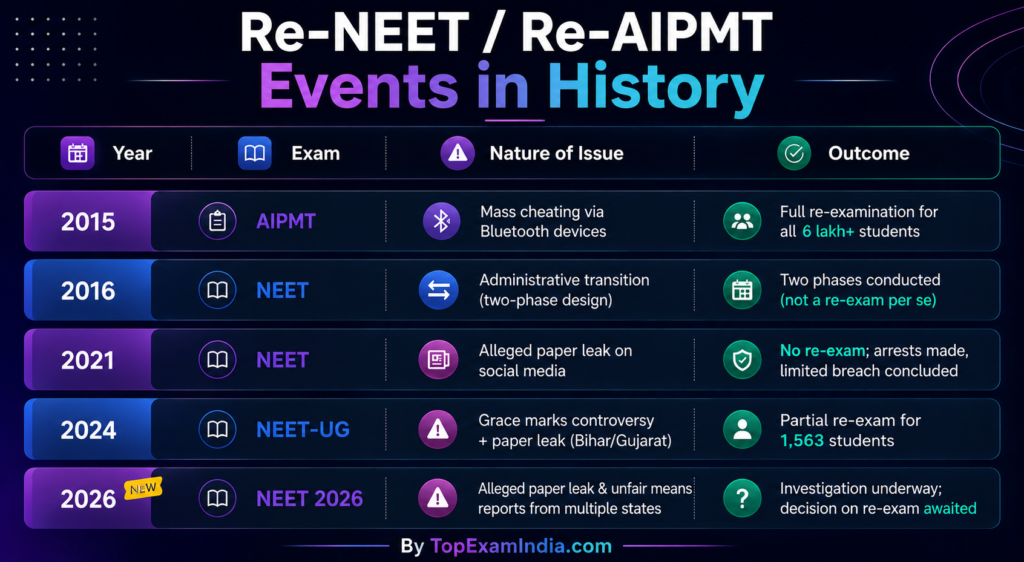
How Many Times Has a Re-NEET Been Conducted? A Year-by-Year Breakdown.
The question most aspirants and parents ask is: how many times has the NEET or its predecessor been cancelled and reconducted in history? Based on documented records and Supreme Court orders, here is the complete timeline:
1. AIPMT 2015 — Cancelled and Reconducted (June 2015)
This is the first major instance of a full-scale re-examination in the history of India’s medical entrance system.
The AIPMT 2015 was originally conducted on May 3, 2015. However, it was marred by a serious cheating scandal. Haryana police caught individuals — including two dentists and an MBBS student — who were allegedly passing answer keys to candidates during the examination using specially designed vests embedded with SIM card units and Bluetooth devices.
The scandal shook the nation. Over six lakh (600,000) students were affected. The Supreme Court, after reviewing the evidence, took the extraordinary step of cancelling the entire AIPMT 2015 examination. A re-examination was ordered and subsequently conducted — making this the first confirmed instance of a full re-examination in Indian medical entrance history.
This event also accelerated the argument for a more secure NEET: a single, centrally monitored, technologically secured exam was seen as the way forward to prevent such widespread malpractice in the future.
2. NEET 2016 — Two-Phase Conduct (NEET Phase I & Phase II)
While this was not technically a re-examination in response to fraud, 2016 was the only year NEET was deliberately split into two separate phases:
NEET Phase I was conducted on May 1, 2016, and NEET Phase II was conducted on July 24, 2016. This two-phase approach was adopted to ease the sudden transition from state-level exams to the newly reinstated NEET. It was a transitional administrative measure, not a response to a paper leak or malpractice. From 2017 onwards, NEET returned to a single-day, single-phase format.
3. NEET 2021 — Viral Paper Scare (No Full Re-Exam Ordered)
In September 2021, a portion of what was claimed to be the NEET 2021 question paper went viral on social media approximately 30 minutes before the exam was set to begin. This caused immediate panic among students, parents, and education authorities across the country.
Police acted swiftly and arrested an 18-year-old candidate, the exam centre administration in-charge, and four other individuals in connection with the alleged breach. However, after investigation, authorities concluded that the leak was limited and did not warrant a full re-examination. No re-NEET was ordered in 2021.
This episode, however, revealed the persistent vulnerabilities in exam security and added to growing public distrust in the NTA’s examination management processes.
4. NEET 2024 — Partial Re-Examination for 1,563 Candidates (June 23, 2024)
This is the most significant and widely covered Re-NEET event in recent history, and it triggered a national crisis of confidence in the entire examination system.
NEET-UG 2024 was conducted on May 5, 2024, with approximately 2.4 million candidates appearing across 571 cities in India and 14 cities abroad — competing for 1,08,940 MBBS seats in over 700 medical institutions nationwide.
The controversy erupted when results were declared on June 4, 2024 — ten days earlier than the previously scheduled date. What made national headlines was the unprecedented number of perfect scores: 67 students achieved 720 out of 720 marks, with 8 of them reportedly from the same examination center in Haryana, all with consecutive roll numbers. Additionally, some students had scores of 718 or 719, which many experts pointed out was mathematically impossible under the NEET marking scheme of +4 for correct and -1 for incorrect answers.
The NTA initially clarified that 1,563 students were awarded compensatory grace marks because they had been given less than the allotted exam time at certain centers in Haryana, Delhi, Chhattisgarh, and other states. However, this explanation only intensified public outrage.
Simultaneously, paper leak allegations emerged from Bihar and Gujarat. In Patna, police arrested 13 individuals, including four examinees, who had allegedly paid between Rs 30 lakh to Rs 50 lakh to obtain the question paper in advance. In Godhra, Gujarat, a center superintendent was found to have coached students from inside the examination hall. The case was transferred to the Central Bureau of Investigation (CBI). The NTA Director General was removed from his post. Forty petitions were filed in various High Courts and the Supreme Court seeking either a full re-NEET or cancellation of results.
On June 13, 2024, the Supreme Court of India ordered the cancellation of scorecards for all 1,563 grace-mark beneficiaries. On June 23, 2024, a partial Re-NEET was conducted for these 1,563 candidates across seven centers in Chhattisgarh, Gujarat, Haryana, Meghalaya, and Chandigarh. Only 813 of the 1,563 eligible students chose to appear; the remaining 750 were absent.
On July 23, 2024, the Supreme Court acknowledged that at least 155 students had directly benefited from the paper leak. However, it ruled that there was no evidence of systemic, widespread failure and declined to order a full re-NEET for all 2.4 million candidates, citing the absence of credible proof of a nationwide compromise. The CBI ultimately arrested 36 persons in connection with the NEET 2024 paper leak case.
5. NEET 2026 — Partial Re-Examination for affecting over 22 lakh students Candidates (May 3, 2026)
NEET UG 2026 has been officially canceled after a major paper leak scandal, affecting more than 2.2 million students. The National Testing Agency (NTA) has confirmed that a re-examination will be held in June 2026, and there will be no new registration or additional fees for it. The central government has ordered the CBI to investigate this leak, which has already led to several arrests in many states. Investigation by CBI Till, over 45 People are arrested. CBI filed FIR against them.
The Real Impact on Students
The Real Impact on Students re-examination is never just an administrative decision — it carries an enormous human cost. For students who have already appeared, the announcement of a possible re-NEET brings months of additional anxiety, disrupted schedules, and uncertainty over admission timelines. Coaching institutes must recalibrate their strategies. Students already enrolled in colleges face delayed counselling. Parents face financial strain from extended preparation periods.
The 2015 AIPMT cancellation displaced over six lakh students. The 2024 controversy affected the mental health of millions more, even those who were not directly impacted by the irregularities. It also sparked a national debate about the fairness of a single exam deciding the medical career of over two million young people every year.
What Should NEET Aspirants of 2025–2026 Learn from This History?
First, always stay updated from official sources. In times of controversy, misinformation spreads fast across social media. Trust only the NTA’s official website, nta.ac.in, and Supreme Court orders reported by credible news outlets.
Second, understand your rights as a candidate. If you face time loss or exam disruption at your center on exam day, document it immediately and report to the invigilator in writing. Keep your admit card and all exam-day evidence carefully.
Third, do not panic at rumors. Not every paper leak claim leads to a full re-examination. Courts examine evidence rigorously before ordering a re-test affecting millions of students. History shows that full re-exams are rare and only ordered when evidence is overwhelming.
Fourth and most importantly, prepare as if there is not second chance. The courts have repeatedly shown reluctance to order full re-exams unless systemic failure is proven beyond doubt. Your best protection is thorough, honest, and rigorous preparation.
Important Links
For NEET-specific notices: Exams.nta.ac.in
Twitter (X) handle link: https://twitter.com/NTA_Exams
Conclusion
The history of Re-NEET in India is the history of a system struggling to become worthy of the trust that millions of students place in it every single year. From the AIPMT 2015 cheating scandal — India’s first full re-examination in the medical entrance space — to the partial re-NEET of June 2024, each incident has exposed cracks in exam administration, security protocols, and institutional oversight mechanisms.
In documented history, there have been two confirmed Re-NEET or Re-AIPMT events: the AIPMT 2015 full re-examination, and the NEET 2024 partial re-examination for 1,563 candidates. A third contested situation arose in 2021, which was resolved without a re-examination.
For every aspirant reading this — your dedication and hard work are your most powerful shields. The exam system has flaws, and reforms are ongoing. But the doctor India needs tomorrow is the one who keeps studying today.
Disclaimer: This article is written for informational and educational purposes only. For the latest official updates on NEET examinations, always refer to the National Testing Agency (NTA) at nta.ac.in or the official NEET website.